EN
EN

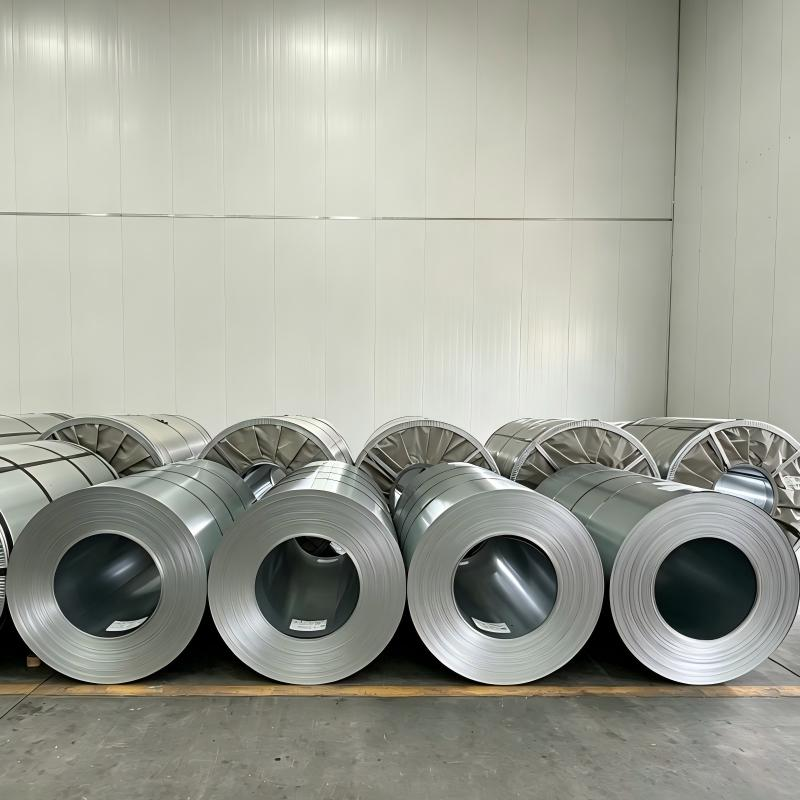
How to Calculate Appropriate Zinc Coating Weight for Galvanized Steel Coil
If you have spent any time sourcing hot-dip galvanized steel coil for construction or roofing projects, you probably started by checking price per tonne. Most buyers do. But somewhere along the way—sometimes after one disappointing shipment, sometimes after watching a Z80-coated roof sheet rust within three years in a coastal town—the question shifts. The number that really matters becomes: what is the right zinc coating weight for this specific job?
As a procurement engineer who has reviewed hundreds of mill test certificates, the clearest service I can offer is a straightforward explanation of how zinc coating weight is defined, calculated, and how to work backward from your project's corrosion environment to the correct specification.
What Zinc Coating Weight Actually Measures
Zinc coating weight—sometimes called coating mass—is expressed in grams per square meter (g/m²). It represents the total mass of zinc deposited on both sides of a given square meter of galvanized steel sheet. By convention, this figure represents a total-both-sides measurement unless explicitly stated otherwise.
For example, a galvanized steel coil designated Z275 carries 275 g/m² of zinc in total: 137.5 g/m² on the top surface and 137.5 g/m² on the bottom. This symmetry holds for most commodity coil products, but it is worth confirming with your supplier when different exposure conditions exist on each face.
The Core Calculation: Converting Between Coating Weight and Coating Thickness
Buyers and quality inspectors sometimes receive coating measurements expressed in microns (µm) rather than g/m². The two are directly convertible through zinc's density. In industrial practice, the following conversion formulas apply:
- Coating Mass (g/m²) = Coating Thickness (µm) × 7.05
- Coating Thickness (µm) = Coating Mass (g/m²) × 0.14
These relationships are based on zinc's density of approximately 7,135 kg/m³, a physical constant that applies to the solidified zinc layer on hot-dip galvanized sheet. The factor 7.05 is a practical rounding used in industry standards and testing protocols.
Take a practical case: a coating thickness gauge reads 20 µm per side on a galvanized steel coil. The per-side coating weight is 20 × 7.05 = 141 g/m², and the total both-sides coating weight comes to approximately 282 g/m²—putting this coil close to a Z275 designation. Conversely, if a mill test certificate shows Z180, the per-side thickness is 180 × 0.14 ÷ 2 = 12.6 µm.
This formula matters because coating thickness gauges measure per-side thickness, while most commercial designations state total-both-sides mass. Understanding the conversion prevents specification mismatches at goods receipt.
Designation Systems: EN Z-Series vs. ASTM G-Series
International sourcing for galvanized steel coil involves at least two major designation systems. The two most common systems when ordering from Chinese, European, or North American mills are:
- EN 10346 (European standard) — Z designation: The "Z" number directly states the total coating mass in g/m². Z80 = 80 g/m², Z120 = 120 g/m², Z180 = 180 g/m², Z275 = 275 g/m².
- ASTM A653 (North American standard) — G designation: The "G" number states the coating weight in ounces per square foot (oz/ft²), total both sides. G60 = 0.60 oz/ft² ≈ 180 g/m²; G90 = 0.90 oz/ft² ≈ 275 g/m². To convert: multiply oz/ft² by 305.15 to get g/m².
For buyers importing from Asian mills—including suppliers producing under GB/T 2518 or JIS G3302—an additional alignment check is needed, since Chinese GB and Japanese JIS standards use their own notation. When in doubt, request the numeric coating mass in g/m² explicitly rather than relying on grade letter codes.
Selecting Appropriate Coating Weight Based on Environment
The practical approach is to define the corrosion environment first, then work backward to the minimum adequate coating weight for your galvanized steel coil order. A framework consistent with EN ISO 9223 corrosion categories:
- Indoor, dry environments (C1–C2): Z60–Z120 is adequate for interior framing, cable trays, and shelving.
- Outdoor, moderate humidity—general construction (C3): Z120–Z180 provides reliable protection for most roofing and cladding in non-aggressive climates.
- Outdoor, higher humidity—tropical or semi-coastal (C3–C4): Z275 is the standard recommendation for roofing and wall panels in West Africa, South America, and similar markets. This is the most commonly ordered weight range for export construction projects.
- Coastal or marine environments (C4–C5): Z275 minimum, with Z350 or higher when direct salt spray exposure is expected. Industrial zones may require Z450 or above.
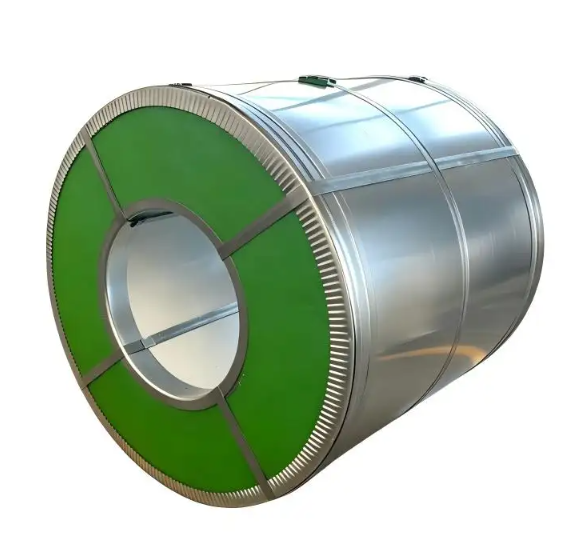
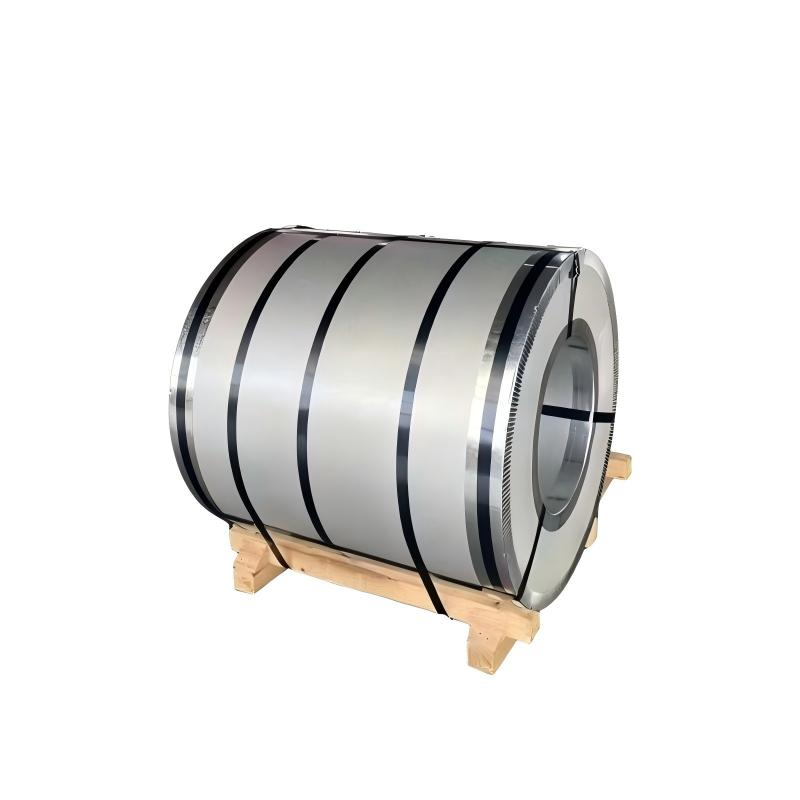
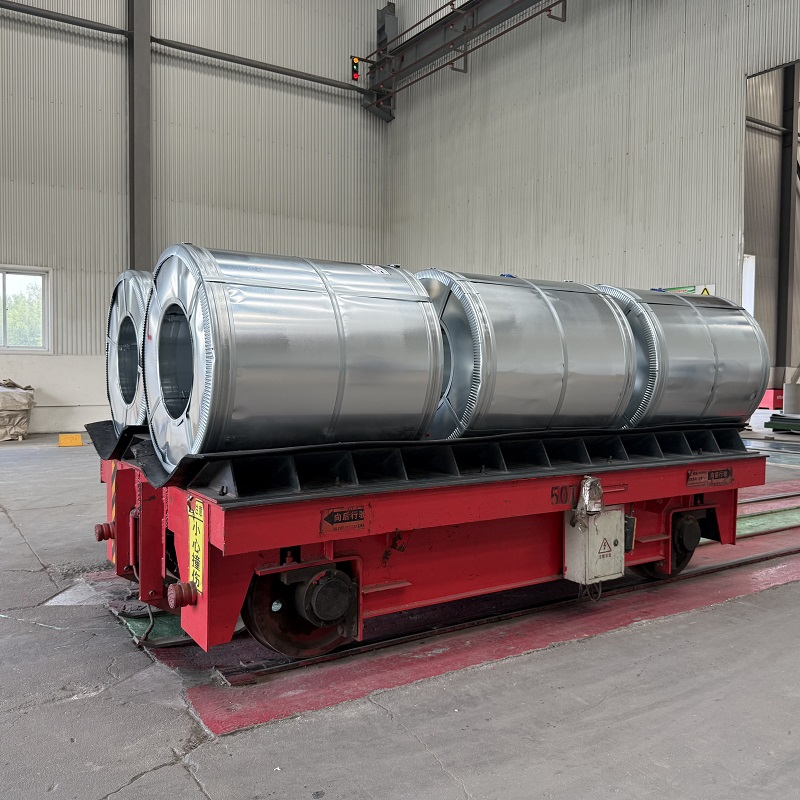
Regular spangle galvanized steel coil with Z80 coating and regular spangle galvanized steel coil with Z275 coating look nearly identical on visual inspection—but their protective life in a humid tropical climate can differ by a factor of three or more. Getting the coating weight right before ordering is far less expensive than discovering this difference after installation.
Surface Finish and Coating Weight: Understanding Regular Spangle
Regular spangle galvanized steel coil refers to the characteristic crystalline flower pattern that forms naturally on the surface during standard hot-dip galvanizing. The spangle pattern is a visual marker of the coating, not a determinant of its protective weight. A regular spangle finish can be applied at any coating weight from Z60 to Z600.
Buyers sometimes specify minimized spangle or zero spangle for smoother-surface downstream applications such as roll-forming for exposed panels. The corrosion protection calculation remains the same regardless of spangle type: it depends on coating weight (g/m²), not surface texture.
What to Ask a Galvanized Steel Coil Factory
When sourcing from a galvanized steel coil factory directly, asking the right technical questions at the inquiry stage saves time and prevents costly specification mismatches. Based on procurement experience with Chinese mills, the questions that consistently matter most are:
- Nominal coating weight (g/m²) and per-side tolerance range in the mill's process specification
- Whether the MTC coating weight is measured by chemical stripping, XRF, or magnetic induction—and which standard the test follows (EN 10346, ASTM A653, or equivalent)
- Whether real-time coating weight monitoring is used on the hot-dip line, which significantly reduces batch-to-batch variation
- Availability of pre-shipment third-party inspection for coating weight verification (SGS, BV, or equivalent)
Yuanhe Steel, based in Shenyang, produces galvanized steel coil with customer-specified coating weights for GI coil orders, and supports pre-shipment coating weight verification through third-party inspection coordination. For buyers in North America, Africa, South America, and Europe who need galvanized steel coil to a specified coating weight with documented compliance, contact the team at [email protected] or via yuanheppgi.com.
Summary: A Practical Calculation Checklist
- Define the end-use corrosion environment (indoor, outdoor moderate, outdoor tropical, coastal/marine).
- Map the environment to the appropriate coating weight range using EN ISO 9223 corrosion category guidance.
- Confirm the designation system (EN Z-series, ASTM G-series) and convert to a common g/m² figure.
- Apply the conversion: Coating Thickness (µm) = Coating Mass (g/m²) × 0.14 per side to verify against thickness gauge readings at goods receipt.
- Request a mill test certificate and, where warranted, third-party coating weight verification before shipment.
The calculation itself is not complicated. What trips up buyers is not the math—it is the gap between specifying a coating weight and understanding what that number actually means in a given installation environment. Close that gap at the order stage, and the rest usually takes care of itself.