EN
EN

How Long Is the Anti-Rust Lifespan of Standard Hot Dipped Galvanized Steel?
Provided the zinc coating weight meets specification and the installation environment is correctly assessed, standard hot dipped galvanized steel can deliver anywhere from 15 years to well over 70 years of rust-free service life. That wide range is not a hedge — it reflects genuine technical reality. The lifespan is not fixed at the factory; it is determined by three variables working together: coating weight, exposure category, and base metal thickness.
As a project manager specifying structural or cladding materials for construction in Africa, South America, North America, or Europe, understanding this relationship is the difference between a one-generation asset and a material that underperforms within a decade.
How Hot-Dip Galvanizing Creates Anti-Rust Protection
Hot-dip galvanizing is the process of immersing cleaned steel in a bath of molten zinc at approximately 450 °C (842 °F). The zinc metallurgically bonds to the steel surface, forming a series of zinc-iron alloy layers topped by a pure zinc outer layer. This coating protects steel through two mechanisms simultaneously: a barrier layer that physically blocks moisture and oxygen, and cathodic (sacrificial) protection that continues to shield exposed steel even at cut edges or minor surface damage — something electroplated finishes cannot offer.
The result is a coating that actively prolongs steel service life rather than merely delaying the onset of corrosion. Hot-dipped galvanized steel will eventually show rust once the zinc is fully consumed, but the zinc depletes at a known and predictable rate that varies by environment.
Coating Weight Is the Primary Lifespan Driver
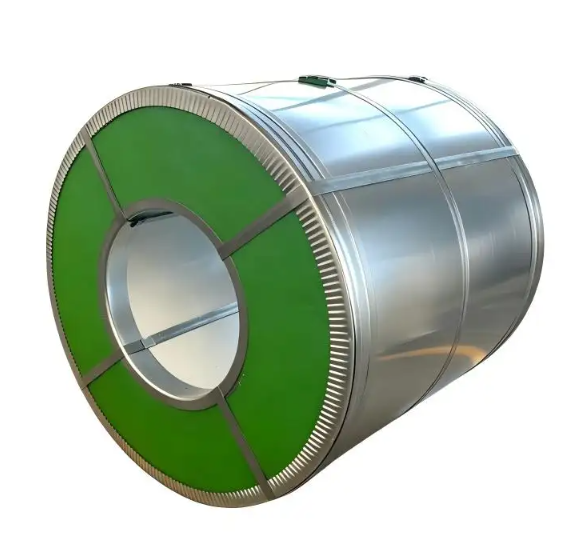
International standards define hot dipped galvanized steel coil coating weights using two main systems. EN 10346, the standard most relevant to GI coils used in construction globally, expresses total coating mass (both surfaces combined) in grams per square metre: Z80, Z100, Z120, Z140, Z200, Z275, and Z350. ASTM A653 (for galvanized sheet and strip) uses ounces per square foot or grams per square metre, with designations like G60, G90, G115, and G165.
Under EN 10346, each higher coating designation must meet a minimum total zinc mass per square metre — this ensures progressively longer corrosion protection as the designation steps up. A Z120 coating provides approximately 8.5 µm of zinc per side; Z275 provides around 19 µm per side — more than twice the zinc reservoir for the zinc consumption process to draw from before bare steel is exposed.
With all other variables held constant, thicker zinc coating consistently means longer service life. This is not a marketing claim — it is the explicit position of ASTM A123/A123M, the specification governing hot-dip galvanized coatings on fabricated steel products, which contains no maximum coating thickness requirement for exactly this reason.
Expected Anti-Rust Lifespan by Exposure Environment
The zinc coating on hot dipped galvanized steel is consumed by atmospheric corrosion at a rate that depends heavily on environmental aggressiveness. The table below summarizes expected time to first maintenance (first visible rust on 5% of surface) for standard coating grades across four exposure categories, based on industry-published data from the American Galvanizers Association and comparable sources:
| Exposure Category | Typical Environment | Z80 (GI coil, standard) | Z120 (GI coil, common) | Z275 (heavy coating) |
|---|---|---|---|---|
| Rural / Low Corrosivity | Inland agricultural areas, low humidity, minimal industrial pollution | 30–40 years | 50+ years | 70+ years |
| Urban / Moderate | City environments, moderate SO₂ and particulates | 20–30 years | 30–40 years | 50–60 years |
| Industrial / High Corrosivity | Near chemical plants, heavy manufacturing, high SO₂ | 10–15 years | 20–25 years | 35–45 years |
| Marine / Coastal | Beachfront, salt-spray zones, high humidity coasts | 8–12 years | 15–20 years | 25–35 years |
For structural-thickness hot dipped galvanized steel — components exceeding 6 mm base metal thickness — the American Galvanizers Association has documented lifetimes reaching 72–73 years to first maintenance even in industrial atmospheres, because thicker steel also receives a proportionally heavier zinc coating under ASTM A123 coating grade rules.
The Mistake That Shortens Lifespan Most Often
One common roofing and structural project mistake is specifying standard GI coils with Z80 or Z100 coating for a coastal tropical environment, only to find red rust spots emerging within the first two rainy seasons. This failure is not a product defect — it is a specification error driven by insufficient environmental assessment at the procurement stage.
While hot-dipped galvanized steel performs exceptionally well in controlled conditions, it requires the buyer to honestly classify the installation environment before selecting coating weight. In coastal West Africa, Southeast Asia, or the Caribbean, Z80 GI coil is undersized for roofing or structural cladding. At minimum, Z200 or Z275 should be specified, and for the most exposed marine zones, Galvalume (aluminum-zinc alloy, 55% Al–Zn coating) outperforms standard zinc-only GI coil significantly due to the aluminum component's barrier effect.
Sourcing a long service gi coil for construction projects in corrosive environments therefore starts with coating weight selection, not price. A Z275 GI coil quoted at a 15–20% premium over Z80 may deliver three times the service life — a lifecycle cost advantage that justifies the upfront difference for most project budgets.
Where Weather-Resistant Galvalume Fits Into the Picture
For buyers whose projects face particularly demanding environments — coastal industrial zones, chemical processing facilities, or equatorial climates with sustained high humidity — weather resistant galvalume steel coil extends the protection envelope beyond what standard zinc-only coatings deliver. The aluminum-zinc alloy coating in Galvalume forms a tightly adherent barrier layer rather than relying primarily on sacrificial zinc dissolution, which means the coating depletes more slowly in aggressive atmospheres.
After two years of tropical coastal exposure, the difference in rust resistance between standard GI roofing sheets and Galvalume-coated panels becomes clearly visible to the naked eye. For a 20–25 year project lifecycle, this performance gap is material in both the engineering and commercial sense.
Practical Guidance for Procurement and Specification
When specifying hot dipped galvanized steel for construction projects in North America, Africa, South America, or Europe, the coating weight selection should follow a systematic process:
- Classify the exposure environment using ISO 9223 corrosivity categories (C1–C5) or equivalent regional classification. Coastal zones in Africa and South America typically fall in C4 (high) or C5 (very high) categories.
- Map the exposure category to minimum coating weight: C1–C2 can use Z80–Z120; C3 should use Z120–Z200; C4–C5 requires Z200–Z275 minimum, or consider switching to Galvalume for the most demanding conditions.
- Request mill test reports (MTRs) confirming actual measured coating weight for the specific coils in your order, not just the nominal designation. MTRs traceable to individual coil heat numbers allow you to verify that delivered coating weight meets specification.
- Confirm applicable standard — EN 10346 for European or African markets; ASTM A653/A653M for North American projects — so that the coating designation on the MTC maps correctly to your project specification.
At Shenyang Yuanhe Steel Trading Co., Ltd., our GI coils are sourced from certified northeast China mills and are available in coating grades from Z80 through Z275 under EN 10346, as well as equivalent ASTM designations for North American buyers. Mill test reports are provided for every shipment, and pre-shipment third-party inspection by SGS or BV is available on request for specification-critical applications.
If you are specifying hot dipped galvanized steel for a construction project and need guidance on selecting the correct coating weight for your climate zone and application, our team is available to provide a product recommendation based on your project requirements. Contact Leo Liu at +86-18642064006 or [email protected] to request a quotation or technical consultation.